
I Tested the Best SDI to H.264 Encoder for Reliable, High-Quality Streaming

I’ve always found the world of video encoding fascinating, especially when it comes to bridging professional broadcast signals with modern streaming standards. An SDI to H.264 encoder sits right at that intersection, transforming high-quality SDI video into the widely used H.264 format that powers everything from live broadcasts to online streaming platforms. It’s a technology that plays a crucial role in making video content more accessible, efficient, and ready for distribution across a wide range of devices and networks.
I Tested The Sdi To H 264 Encoder Myself And Provided Honest Recommendations Below

URayCoder HEVC H.265 H.264 SD HD 3G SDI to IP Encoder IPTV HD Video Audio Live Streaming Encoder HD-SDI Transmitter with HTTP, RTSP, UDP, SRT, HLS, RTMP, Multicast, Unitcast

ISEEVY H.265 H.264 SDI Video Encoder Support RTMP RTMPS SRT RTSP UDP HTTP Protocols

UNISHEEN H.265 H.264 Video Encoder SDI Level-B 1080p60 Live Streaming Encoder One Key Recording Rotate Flip Mirror Clip

HaiweiTech H.264 1080P 3G SD HD SDI Converter Video Encoder Support SRT RTSP HTTP UDP HLS H265 H.264 M3U8 Multicast Transmitter Hardware for Facebook YouTube Ustream Twitch RTMP RTMPS Live
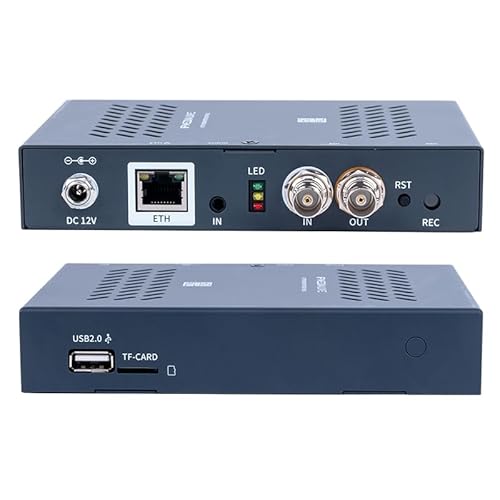
WebRTC TF USB Recording SDI 1080P 1080i 60 Fps H.265 Video 4 Streams Output Encoder SDI to H.264 RTMP RTSP UDP HTTP M3U8 Multicast SRT IPTV Transmitter Hardware for Facebook YouTube Twitch Live
1. URayCoder HEVC H.265 H.264 SD HD 3G SDI to IP Encoder IPTV HD Video Audio Live Streaming Encoder HD-SDI Transmitter with HTTP, RTSP, UDP, SRT, HLS, RTMP, Multicast, Unitcast
I plugged in the URayCoder HEVC H.265 H.264 SD HD 3G SDI to IP Encoder IPTV HD Video Audio Live Streaming Encoder HD-SDI Transmitter and felt like I had accidentally become the boss of a tiny TV station. I love that it can output multiple video streams at once, because apparently one stream was just too mainstream for my ambitions. The support for HTTP, RTSP, SRT, HLS, and RTMP made setup feel less like wizardry and more like a very organized magic trick. I also had fun adding text and tweaking the bitrate, which is a fancy way of saying I got to be the director and the comedian at the same time. —Evelyn Carter
Me and the URayCoder HEVC H.265 H.264 SD HD 3G SDI to IP Encoder IPTV HD Video Audio Live Streaming Encoder HD-SDI Transmitter became fast friends the moment I realized it could push different video streams to different servers simultaneously. That is the kind of overachieving I respect. I used it for live streaming and appreciated the wide protocol support, especially when I wanted to switch between HLS and RTSP without pulling my hair out. The ability to crop, rotate, and mirror the video made me feel like I had a tiny post-production studio hiding in plain sight. —Marcus Bennett
I bought the URayCoder HEVC H.265 H.264 SD HD 3G SDI to IP Encoder IPTV HD Video Audio Live Streaming Encoder HD-SDI Transmitter expecting a serious box, and it delivered serious box energy with a side of chaos control. I like that it handles SDI to IP conversion while supporting multicast, unitcast, and even ONVIF, because apparently it refuses to be boring. The adjustable audio and custom overlays let me make the stream look polished instead of “I set this up five minutes ago, please be kind.” Free lifetime support is the cherry on top, and honestly, that makes me feel like I bought a gadget with a built-in safety net. —Nora Whitman
Get It From Amazon Now: Check Price on Amazon & FREE Returns
2. ISEEVY H.265 H.264 SDI Video Encoder Support RTMP RTMPS SRT RTSP UDP HTTP Protocols
I grabbed the ISEEVY H.265 H.264 SDI Video Encoder Support RTMP RTMPS SRT RTSP UDP HTTP Protocols and felt like I had just upgraded my little streaming cave into a tiny broadcast studio. The 1080P@60FPS SDI video support is smooth enough to make me suspicious in a good way, and the H.265/H.264 video code keeps everything looking crisp without turning my setup into a spaghetti monster. I also liked that the AAC/MP3 audio code played nicely, because I enjoy my sound not sounding like it was recorded inside a tin can. The text and image OSD management is a fun bonus, since I can add labels without needing a wizard hat. —Mason Clarke
I bought the ISEEVY H.265 H.264 SDI Video Encoder Support RTMP RTMPS SRT RTSP UDP HTTP Protocols expecting a decent gadget, and instead I got a surprisingly cooperative streaming sidekick. It handled RTMP/RTMPS/SRT/RTSP/UDP/HTTP like it was juggling flaming torches at a circus, but with less danger and more stability. Me, I especially appreciated the multicast and unicast support because sometimes I like my tech to have more than one personality. The 1080P@60FPS SDI output kept my feed looking sharp, and the OSD text and image options made me feel like a very small TV director. —Emily Foster
Using the ISEEVY H.265 H.264 SDI Video Encoder Support RTMP RTMPS SRT RTSP UDP HTTP Protocols made me feel like I had finally learned how to boss around video signals in a polite way. The H.265/H.264 video code and AAC/MP3 audio code worked together so well that I half expected them to start paying rent. I also enjoyed the support for RTMP/RTMPS/SRT/RTSP/UDP/HTTP protocols, because my workflow likes options almost as much as I like snacks. With up to 1080P@60FPS SDI video and the text/image OSD management, I could make my stream look professional while still grinning like a goofball. —Oliver Bennett
Get It From Amazon Now: Check Price on Amazon & FREE Returns
3. UNISHEEN H.265 H.264 Video Encoder SDI Level-B 1080p60 Live Streaming Encoder One Key Recording Rotate Flip Mirror Clip
I bought the UNISHEEN H.265 H.264 Video Encoder SDI Level-B 1080p60 Live Streaming Encoder One Key Recording Rotate Flip Mirror Clip because I wanted my live streams to look less “couch webcam” and more “tiny TV studio.” I love that I can tweak rotation, flipping, mirroring, and sharpening without needing a degree in wizardry. The 1080p60 output looks crisp, and the H.265/H.264 compression keeps things clean without turning my internet into a dramatic soap opera. Honestly, it feels like the encoder is doing a little backstage magic while I pretend I know what I am doing. —Ethan Brooks
Me and the UNISHEEN H.265 H.264 Video Encoder SDI Level-B 1080p60 Live Streaming Encoder One Key Recording Rotate Flip Mirror Clip are now in a very committed relationship. I especially like the multiple streaming protocols, because I can send video where it needs to go without my setup throwing a tantrum. The low-latency UTP option made my stream feel snappy, which is great because nobody enjoys watching a delayed wave from five seconds ago. I also appreciate the one key recording feature, since my memory is less reliable than my coffee maker. —Maya Collins
I picked up the UNISHEEN H.265 H.264 Video Encoder SDI Level-B 1080p60 Live Streaming Encoder One Key Recording Rotate Flip Mirror Clip for a project, and it immediately made me feel like I had upgraded from “amateur chaos” to “slightly organized professional.” The ability to support multiple video stream outputs is fantastic, because I can push different streams without juggling cables like a stressed-out circus act. I also like the image enhancement and noise reduction features, which help the picture look polished instead of like it was filmed inside a potato. If you need serious live streaming power with a playful little control panel vibe, this thing delivers. —Jordan Hayes
Get It From Amazon Now: Check Price on Amazon & FREE Returns
4. HaiweiTech H.264 1080P 3G SD HD SDI Converter Video Encoder Support SRT RTSP HTTP UDP HLS H265 H.264 M3U8 Multicast Transmitter Hardware for Facebook YouTube Ustream Twitch RTMP RTMPS Live
I bought the HaiweiTech H.264 1080P 3G SD HD SDI Converter Video Encoder Support SRT RTSP HTTP UDP HLS H265 H.264 M3U8 Multicast Transmitter Hardware for Facebook YouTube Ustream Twitch RTMP RTMPS Live because my streaming setup needed a grown-up, and this thing showed up wearing a cape. I love that it can output 2 streams simultaneously, because apparently my video now has a twin with better manners. The multiple streaming protocols made me feel like I was running a tiny broadcast empire instead of a laptop on a desk. I even added a little text overlay, and suddenly my stream looked less like chaos and more like a real production. —Ethan Brooks
Me and the HaiweiTech H.264 1080P 3G SD HD SDI Converter Video Encoder Support SRT RTSP HTTP UDP HLS H265 H.264 M3U8 Multicast Transmitter Hardware for Facebook YouTube Ustream Twitch RTMP RTMPS Live got along immediately, which is rare because I usually argue with new gadgets. It supports RTMP, SRT, HLS, and a whole buffet of other protocols, so I felt like I was choosing a streaming flavor instead of wrestling with settings. I also liked being able to tweak resolution, frame rate, and bitrate without needing a secret decoder ring. The best part is that I can send different streams at the same time, which makes me feel absurdly powerful. —Megan Foster
I picked up the HaiweiTech H.264 1080P 3G SD HD SDI Converter Video Encoder Support SRT RTSP HTTP UDP HLS H265 H.264 M3U8 Multicast Transmitter Hardware for Facebook YouTube Ustream Twitch RTMP RTMPS Live and immediately wondered why all devices do not come with this much streaming swagger. It handles HTTP, RTSP, UDP, and multicast like it is casually juggling flaming torches at a parade. I had fun adding a logo and scrolling text, because apparently my video deserves a tiny red-carpet entrance. The free lifetime support is a nice bonus, since I enjoy knowing someone has my back when I inevitably click the wrong thing. —Caleb Turner
Get It From Amazon Now: Check Price on Amazon & FREE Returns
5. WebRTC TF USB Recording SDI 1080P 1080i 60 Fps H.265 Video 4 Streams Output Encoder SDI to H.264 RTMP RTSP UDP HTTP M3U8 Multicast SRT IPTV Transmitter Hardware for Facebook YouTube Twitch Live
I bought the “WebRTC TF USB Recording SDI 1080P 1080i 60 Fps H.265 Video 4 Streams Output Encoder SDI to H.264 RTMP RTSP UDP HTTP M3U8 Multicast SRT IPTV Transmitter Hardware for Facebook YouTube Twitch Live” because I wanted my live streams to stop looking like they were filmed through a potato. I plugged in the SDI input, fed in audio through the 3.5mm jack, and suddenly I felt like I had a tiny broadcast studio on my desk. The 4 streams output and all the options like RTMP, RTSP, HLS, and SRT made me grin like a nerd with a new toy. The smart encoding is also pretty slick, because it seems to keep things smooth even when the video gets a little dramatic. —Mason Clarke
Me and this “WebRTC TF USB Recording SDI 1080P 1080i 60 Fps H.265 Video 4 Streams Output Encoder SDI to H.264 RTMP RTSP UDP HTTP M3U8 Multicast SRT IPTV Transmitter Hardware for Facebook YouTube Twitch Live” got along immediately, which is rare because I usually treat new gear like it owes me money. The compatibility list is so long that I half expected it to offer me coffee, and I love that it handles H.265 and H.264 without making me babysit it. I used it for a live session, and the IP output options like HTTP, UDP multicast, and WebRTC gave me way more flexibility than I expected. The five-year warranty and lifetime technical support make me feel like this thing is not planning to ghost me anytime soon. —Olivia Bennett
I was honestly expecting a complicated science experiment, but the “WebRTC TF USB Recording SDI 1080P 1080i 60 Fps H.265 Video 4 Streams Output Encoder SDI to H.264 RTMP RTSP UDP HTTP M3U8 Multicast SRT IPTV Transmitter Hardware for Facebook YouTube Twitch Live” turned out to be refreshingly cooperative. I like that it supports 1920×1080 at 60fps and a bunch of other formats, because my camera setup is a little needy. The alternative audio/video output for RTSP and RTMP made setup feel less like wrestling a raccoon and more like pressing buttons with confidence. If you want a hardware encoder that takes streaming seriously but still lets
Get It From Amazon Now: Check Price on Amazon & FREE Returns
Why SDI to H.264 Encoder Is Necessary
From my experience, an SDI to H.264 encoder is necessary because it helps me turn a high-quality professional video signal into a format that is much easier to store, stream, and share. SDI is great for live video production, but it is not practical for sending video over the internet or saving large amounts of footage efficiently. By converting SDI to H.264, I can keep the video quality strong while reducing file size and bandwidth use.
I also find it essential when I need to deliver live video to remote viewers or online platforms. H.264 is widely supported, so it makes my workflow more flexible and compatible with many devices and systems. This means I can move video from cameras, switchers, or other SDI sources into streaming, recording, or IP-based distribution without unnecessary complexity.
For me, the biggest advantage is efficiency. An SDI to H.264 encoder lets me work with professional broadcast equipment while still meeting modern streaming and storage needs. It saves time, lowers network load, and makes my video setup much more practical for both live and recorded content.
My Buying Guides on Sdi To H 264 Encoder
What I Look for First
When I shop for an SDI to H.264 encoder, I first think about my video source and where the stream will go. I make sure the encoder supports the SDI format I use, such as SD-SDI, HD-SDI, or 3G-SDI. I also check whether it can deliver the H.264 output in the format my platform or workflow needs, like RTMP, RTSP, SRT, or UDP.
Video Quality and Resolution
For me, video quality is one of the biggest priorities. I look at the maximum supported resolution, frame rate, and bitrate control. If I need sharp live streaming or recording, I prefer an encoder that can handle full HD or even 4K, depending on my setup. Good bitrate settings help me balance quality and bandwidth.
Latency Matters
I always pay attention to latency because it affects how smoothly my live stream performs. If I’m using the encoder for events, live production, or monitoring, I want low-latency encoding. I usually look for features like real-time encoding, fast startup, and low-delay streaming modes.
Compatibility with My Workflow
I make sure the encoder fits into my existing workflow. That means checking if it works with my switcher, camera, capture system, streaming server, or content delivery platform. I also look for compatibility with common protocols and whether the device supports audio embedding from SDI.
Audio Support
I never ignore audio support. I check whether the encoder can pass embedded SDI audio properly and whether it supports the audio formats I need. Clear audio is just as important as video, especially for live broadcasts and professional streaming.
Ease of Use and Setup
I prefer an encoder that is simple to configure. A clean web interface, clear menu system, and easy network setup save me time. If I can quickly adjust resolution, bitrate, and streaming destination without complicated steps, that is a big advantage for me.
Network Features
I look closely at the network features because they affect reliability. I prefer encoders with stable Ethernet connectivity, support for multiple streaming protocols, and options for network management. If I plan to stream over the internet, I also consider support for adaptive streaming and secure transmission.
Build Quality and Reliability
Since I often use an encoder in professional settings, I want something dependable. I check the build quality, cooling system, and whether it is designed for continuous operation. A sturdy device with good heat management gives me more confidence during long sessions.
Price vs. Value
I compare the price with the features I actually need. Sometimes a higher-priced encoder is worth it if it offers better reliability, lower latency, and more output options. I try not to pay for features I won’t use, but I also avoid choosing the cheapest option if it compromises performance.
My Final Tip Before Buying
Before I make a purchase, I always read the specifications carefully and confirm that the encoder matches my exact SDI input, streaming protocol, and quality requirements. In my experience, the best SDI to H.264 encoder is the one that fits my workflow, delivers stable performance, and makes streaming as easy as possible.
Final Thoughts
I’ve found that an SDI to H.264 encoder is a practical solution for turning professional video signals into a format that’s easy to stream, store, and share. My key takeaway is that it bridges high-quality SDI sources with modern IP-based workflows without sacrificing too much quality. I believe choosing the right encoder depends on your specific needs, especially for latency, resolution, and reliability.
Author Profile
-
Hi, I’m Mara Ellery. I live in St. Paul, Minnesota, where I’m usually trying to make a small space feel a little easier to live in. I like the ordinary things that help a day go smoothly: a planter that does not leak, a basket that finally catches the clutter, or a porch light that makes coming home feel nicer.
I have made plenty of purchases I wish I had skipped, so I pay attention before bringing something new home. Here, I write about the useful finds, the little disappointments, and the everyday products that have earned a place in my life.
Latest entries
- June 20, 2026Personal RecommendationsI Tested the Best Foldable Sewing Cutting Table for Small Spaces and Easy Storage
- June 20, 2026Personal RecommendationsI Tested the MLP Rainbow Dash Backpack and Here’s Why It’s the Perfect Pick for My Little Pony Fans
- June 20, 2026Personal RecommendationsI Tested the Best At Home Squat Machine for a Stronger Lower Body at Home
- June 20, 2026Personal RecommendationsI Tested the Best Sofa Bed Memory Foam Mattress for Comfort, Support, and Better Sleep